
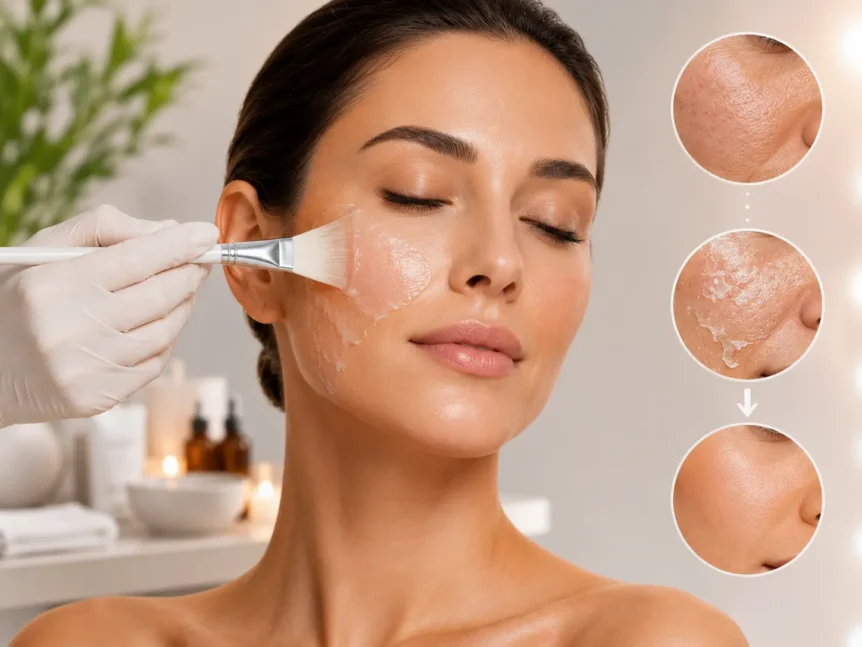
You notice it first in ordinary light. The skin that used to reflect light evenly now looks flatter, a little rougher, and less consistent in tone. Fine lines linger after expression, and sun damage starts to show through makeup instead of remaining unseen beneath it.
That is often the point when patients start asking about facial peels.
In the clinic, peels are rarely a vanity treatment in isolation. They are one tool in a longer anti-aging plan to improve brightness, texture, pigment irregularity, and early lines in a controlled way. Used well, they refresh the skin’s surface and make it more receptive to regenerative care such as PRP and cell-based therapies, which support repair and help results look healthier rather than overtreated.
Patients usually want a visible change without surgery or an unnatural finish. A well-chosen peel can do that, but the trade-off matters. Stronger formulas may produce more correction and more downtime. Gentler options ask for patience and a series-based approach. Good planning matters more than intensity.
For patients weighing peels against other lower-downtime options, these non-surgical ways to look younger give useful context. The right plan is rarely a single treatment. It is a sequence, timed properly, with skin quality, recovery, and long-term maintenance all considered from the start.
Your Path to Renewed and Radiant Skin
A good peel isn’t about making skin look processed. It’s about removing what’s tired on the surface so healthier skin can come forward in a controlled way.
In practice, that matters because aging skin rarely has just one issue. A patient may have fine lines, patchy pigment, rough texture, mild breakouts, and a loss of brightness all at once. Facial peels are useful because they can be adjusted to target some of those concerns gently or more aggressively, depending on depth, formulation, skin tone, and recovery tolerance.
Why peels remain a clinical mainstay
Facial peels work because they’re among the clearest examples of controlled injury used for repair. The skin responds to the peel by shedding damaged outer layers and beginning a renewal process. When the treatment is carefully chosen, it can improve texture, soften visible photoaging, and create a cleaner canvas for long-term maintenance.
What doesn’t work is treating every face the same. A peel that helps one patient with oily, breakout-prone skin may irritate another with reactive skin or deepen pigmentation risk in the wrong setting. The treatment itself isn’t the whole answer. Selection is.
The best peel is not the strongest peel. It’s the one your skin can heal from predictably.
What patients usually want
Most consultations circle back to a few familiar goals:
- Brighter skin: Less dullness and a more reflective surface
- Smoother texture: Fewer rough patches and less visible congestion
- More even tone: Reduced appearance of blotchiness and sun-related discoloration
- A softer age signature: Fine lines that don’t catch the light as sharply
When patients understand that peels are part of a program, not a magic event, they tend to be happier with the result and more willing to protect it.
Understanding How Facial Peels Renew Your Skin
Think of a facial peel the way a craftsperson thinks about refinishing wood. You don’t improve the surface by painting over splinters, oxidation, and uneven stain. You remove damaged material first, then let the surface rebuild more cleanly.
Skin behaves in a similar way. A peel applies a controlled chemical solution to the skin so the outer damaged layers loosen and shed. That visible exfoliation is only part of the story. Beneath it, the skin begins a repair response that can improve texture and overall tone over time.
What the peel is actually targeting
The skin has layers, and peel depth determines where the treatment works most strongly.
- Superficial peels mainly act within the epidermis, the outermost layer.
- Medium-depth peels extend farther, reaching into the papillary dermis.
- Deep peels go deeper still and are reserved for selected cases because recovery and risk increase substantially.
That depth matters because each concern lives at a different level. Surface dullness, mild uneven tone, and light congestion often respond well to shallower peels. More established photoaging or superficial acne scarring may need a medium-depth approach.
The repair sequence
A well-chosen peel starts a sequence that the skin already knows how to perform:
- Exfoliation begins
The solution disrupts damaged surface cells and creates controlled keratocoagulation or exfoliation, depending on the peel. - Cellular signaling follows
The treated skin shifts into repair mode. The treatment now goes beyond a polishing step. - Structural renewal develops
In deeper peels, fibroblast activity and neocollagenesis help explain why texture and photodamage can improve beyond the immediate peel phase. - Newer skin is revealed
As re-epithelialization completes, the skin often appears smoother, fresher, and more even.
If you’re trying to slow visible skin aging in a broader sense, easy ways to support aging skin often complement treatment planning well.
A peel can refresh the surface quickly, but the most valuable result is often the skin’s more organized healing response afterward.
Why collagen gets mentioned so often
Patients hear “collagen stimulation” frequently, sometimes too loosely. The phrase matters most when peels penetrate beyond the superficial layers. Medium-depth treatments can trigger regenerative changes that go beyond basic exfoliation. That’s why they’re used for concerns like photoaging and superficial scarring, not just glow.
Choosing Your Peel Medical vs Cosmetic Options
Not every peel sold to consumers qualifies as a medical peel, and not every peel performed in a clinic needs to be aggressive. The smart decision starts with matching the peel to the problem, not matching it to a trend.
Superficial peels for maintenance and mild concerns
Superficial peels are often the right starting point for patients who want brighter skin, a smoother feel, and little interruption to work or travel. These are commonly built around acids such as glycolic acid, salicylic acid, mandelic acid, or lactic acid.
Clinical evidence supports that ingredient choice matters. A split-face trial found that 30% salicylic acid peels showed superior sustained improvement in mild-to-moderate acne compared with 30% glycolic acid peels, with fewer side effects, according to a review of chemical peel evidence in dermatology. The same review notes that mandelic acid can be useful for pigmentation and acne in sensitive skin, while lactic acid is often used for gentler anti-aging care.
These peels are often good for:
- mild acne
- dull texture
- early uneven tone
- maintenance between more intensive treatments
What they don’t do well is correct deeper wrinkles or more established sun damage in a single session.
Medium-depth peels for more visible correction
Medium-depth peels move beyond surface polishing. Trichloroacetic acid, often at 30% to 35%, serves as the primary agent for this process. These peels are used for stronger correction of photoaging, superficial scarring, melasma in selected cases, and fine rhytides.
They also come with real recovery. Redness, tightness, shedding, and social downtime are part of the package. Patients who choose this category usually do so because they want a more meaningful result and accept that healing is part of it.
Deep peels for selected severe cases
Deep peels are a category entirely different. They are not casual treatments, and they are not for every skin type or schedule. They may be considered for advanced wrinkling and more severe photoaging under strict clinical supervision.
For many patients, deep resurfacing is more treatment than they need.
| Peel Depth | Primary Concerns | Active Agents | Expected Downtime |
| Superficial | Dullness, mild acne, uneven tone, early texture changes | Glycolic acid, salicylic acid, mandelic acid, lactic acid | Minimal to mild, varies by formula |
| Medium-depth | Photodamage, superficial acne scars, fine rhytides, selected pigment concerns | Trichloroacetic acid, sometimes with Jessner’s solution | About a week or slightly longer, depending on healing |
| Deep | Severe wrinkles, advanced photoaging, and selected scarring cases | Phenol-croton oil formulations | Significant downtime with close supervision |
If you’re weighing peel intensity against gentler skin services, this comparison of a chemical peel versus a facial for anti-aging can help clarify the trade-offs.
Medical versus cosmetic is not just a marketing label
The difference usually comes down to four things:
- Depth of action: Medical peels can target more established damage.
- Candidate screening: A clinician should account for skin type, pigmentation risk, healing history, and current skin condition.
- Aftercare discipline: Stronger peels fail when aftercare fails.
- Expectation setting: Cosmetic peels often refresh. Medical peels can renew, but they ask more from the patient.
Expected Benefits and Potential Risks
Patients deserve a balanced answer on facial peels. When they’re chosen well and performed carefully, they can deliver meaningful improvement. When they’re chosen poorly, they can create irritation, prolonged redness, or pigment problems that take longer to correct than the original concern.
What facial peels can improve
Facial peels are commonly used to address:
- uneven texture
- dull, weathered-looking skin
- fine lines
- superficial acne marks
- visible sun damage
- certain forms of discoloration
- mild active acne, depending on peel type
For patients with more established photodamage, medium-depth TCA peels can do considerably more than a brightening peel. Medium-depth peels using 30% to 35% TCA have shown 70% to 80% improvement in photodamage scores after a single treatment, with 7 to 10 days of downtime for re-epithelialization, according to an expert review on medium-depth chemical peels. That same review notes they are best suited for Fitzpatrick skin types I to IV to help minimize risk.
That sounds appealing, and for the right patient, it is. But downtime is not optional, nor is careful follow-up.
What works: Matching peel depth to the patient’s true problem.
What fails: Using a stronger peel because the patient wants faster results, even when the skin isn’t a good candidate.
What you should expect after treatment
A normal recovery can include:
- redness
- tightness
- flaking or visible peeling
- temporary sensitivity
- increased sun reactivity
Those reactions are not automatically a sign that something is wrong. They’re often part of the expected healing arc. The concern arises when a patient picks at peeling skin, returns to strong active products too quickly, or gets unprotected sun exposure during recovery.
Risks that matter in real practice
The biggest practical risks are not always the rarest ones. In everyday care, clinicians pay close attention to:
- Post-inflammatory hyperpigmentation: Especially important in patients with higher pigmentation risk or recent inflammation.
- Prolonged irritation: More common when the barrier is already compromised before treatment.
- Infection risk: A reason to avoid peels over active skin infections or unstable inflammatory eruptions.
- Scarring: Uncommon with proper selection, but a serious concern when peel depth and skin response are mismatched.
When to postpone or avoid a peel
A peel may need to wait if the skin has:
- active infection
- significant irritation
- a recent sunburn
- an unstable inflammatory flare
- a history that suggests poor healing without additional planning
A proper consultation is essential. A responsible clinician sometimes recommends delaying treatment, choosing a lighter peel, or preparing the skin first. That is not being overly cautious. It is good medicine.
Your Facial Peel Journey at a Clinic
For many patients, anxiety drops once they know exactly what happens. Facial peels are straightforward in experienced hands, but the details matter because each step affects comfort, healing, and final outcome.
Before your appointment
The visit starts with a skin assessment, not the peel itself. The clinician needs to know what bothers you, what products you’re using, how your skin reacts, whether you pigment easily, and whether there is any active inflammation or infection that should delay treatment.
In the days leading up to a peel, many patients are advised to simplify their routine. Excessive exfoliation, heavy sun exposure, and irritating actives can make the skin less predictable. If you’re thinking about value as well as results, this overview of facial peel pricing and what affects it is useful before booking.
During the peel
Most sessions follow a familiar sequence:
- Cleansing and prep
The skin is cleansed and often degreased so the solution applies evenly. - Application
The peel solution is placed in controlled layers. Patients usually describe tingling, warmth, or stinging sensations that rise and then settle. - Endpoint monitoring
The clinician closely monitors the skin for an appropriate response. With some peels, visible frosting helps signal depth. - Completion
Depending on the peel type, the solution may be neutralized or left to complete its action as directed.
The sensation is usually tolerable, but not always comfortable. Stronger peels ask more of the patient than superficial ones do.
Freshly treated skin doesn’t need hero products. It needs calm, moisture, and protection.
Aftercare is where results are protected
Good aftercare is simple, but it has to be followed.
- Use gentle products: Avoid scrubs, retinoids, and aggressive acids until the skin has recovered.
- Let peeling happen naturally: Pulling loose skin can increase irritation and the risk of pigment.
- Protect from the sun: This is one of the most important parts of recovery.
- Keep expectations realistic: Skin may look worse before it looks better during the peeling phase.
Patients traveling for treatment should plan around visibility and comfort, not just the procedure date. The skin may be safe, but not socially camera-ready, for a period of time, depending on peel depth.
Amplifying Results with Regenerative Treatments
A patient may come in asking for a peel to freshen the skin before an event, then decide they want more than a short-term glow. In that setting, the right plan is rarely a single procedure. The better question is how the peel fits into a broader program for collagen support, skin quality, and results that still look like their own face.
Why combination planning makes sense
A peel works at the skin surface and in the upper layers. It helps remove built-up damage, improves tone and texture, and sets off a controlled repair response. That can create better conditions for the next step in treatment, especially for patients whose goals include gradual rejuvenation rather than a single dramatic intervention.
Where PRP and Cell Therapy fit
PRP is often a logical addition after the skin barrier has recovered, particularly for patients focused on texture, radiance, and overall skin quality. For readers comparing options, platelet-rich plasma for skin rejuvenation explains how PRP is used in aesthetic medicine.
Cell Therapy sits in a broader category. It is not a substitute for a peel, nor is it a topical skin treatment. It may be considered as part of a wider anti-aging and wellness strategy for selected patients who want a more integrated plan. At International Clinic of Biological Regeneration, facial peels may be combined with PRP and Cell Therapy within individualized non-surgical rejuvenation programs offered in Mexico and The Bahamas.
The practical benefit of a long-view approach
Each treatment has a different job.
- Peels address visible surface change, such as dullness, uneven pigment, and rough texture.
- PRP can support recovery and complement skin-quality goals.
- Cell Therapy may be considered in patients pursuing a broader regenerative program.
Used thoughtfully, this kind of layering often produces the most natural-looking outcome because no single treatment is being pushed beyond its strengths.
That is the part many standalone peel guides miss. Good anti-aging care is usually cumulative. A peel can refresh the canvas, but long-term improvement often comes from choosing the right sequence, allowing enough healing time, and revisiting the plan as the skin changes with age.
Frequently Asked Questions About Facial Peels
How often should you get a facial peel for the best results
That depends on the depth of the peel, your skin’s recovery pattern, and the problem being treated. Light peels are often used more regularly for maintenance, while medium-depth peels are spaced more cautiously because they ask more of the skin. The appropriate interval should come from a clinician who has examined your skin, not from a generic online schedule.
Are facial peels painful?
Most patients describe superficial peels as tingling or stinging rather than painful. Medium-depth peels feel more intense, with warmth and burning that usually peak during application and then settle. Discomfort is temporary, but stronger peels are not the same experience as a quick spa facial.
Is it safe to travel after a peel?
Often yes, but the timing matters. If you have a light peel, travel may be manageable with strict sun protection and a simple recovery routine. If you have a medium-depth peel, visible peeling, redness, and sensitivity can make travel less convenient. It’s better to plan around healing than to assume you’ll look presentation-ready immediately.
Who should be cautious with facial peels?
Anyone with active skin irritation, infection, unusual sensitivity, or a history of pigmentary problems should be carefully evaluated before treatment. This is also why honesty during consultation matters. The products you use, your travel plans, and how your skin has reacted in the past all influence which peel, if any, makes sense.
If you’re considering facial peels as part of a broader rejuvenation plan, International Clinic of Biological Regeneration offers educational information on non-surgical anti-aging options, including facial peels, PRP, IV infusion therapy, and Cell Therapy at its clinic locations in Mexico and The Bahamas.
This article is for general education only and isn’t a substitute for personal medical advice. Speak with your own physician and an ICBR clinician to decide whether treatment is appropriate for you.